


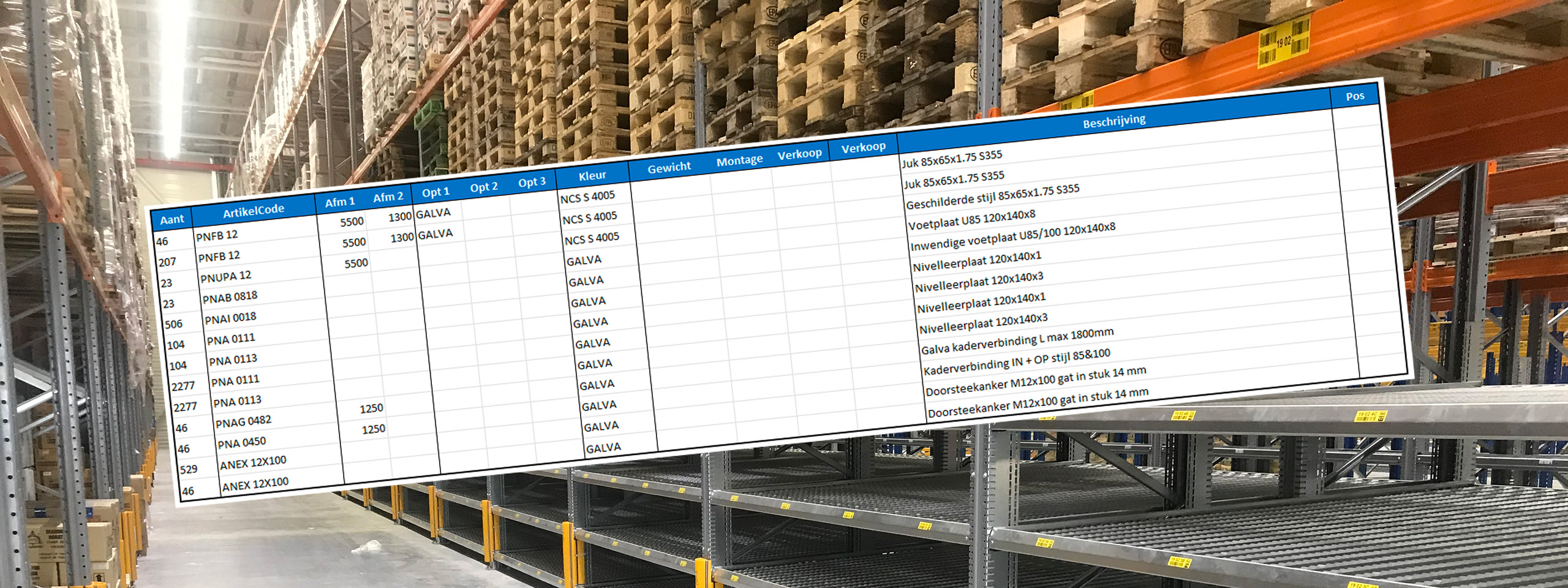
Step 1. Consult the Original Bill of Materials or B.O.M.
0%
Disclaimer: This article describes Dutch legislation and standards regarding pallet racking (including the Bouwbesluit, the Besluit bouwwerken leefomgeving (Bbl), the Omgevingswet, the Arbowet and NEN-EN standards). This information applies to the Dutch situation. If you operate outside the Netherlands, please consult the applicable local legislation and standards.
Why Pallet Racking Falls Under the Bouwbesluit/Bbl
In step 1 of the step-by-step plan to determine which articles you need in your warehouse, we stated:
Since pallet racking falls under Dutch building regulations (the Bouwbesluit), the supplier is required to provide a "0-file" at delivery containing this information.
We understand this may raise some questions. That's why in this article we explain why you need a 0-file or start file, what should be included in it, and who has which responsibility in this regard.
Pallet racking is a 'structure that is not a building' within the meaning of the Bouwbesluit/Bbl
In legal terms, pallet racking is not a loose fitting, but a building structure. This is because racking:
- Is permanently anchored to the floor with base plates and anchors;
- Carries vertical and horizontal loads, comparable to other structural elements;
- And directly contributes to the stability and safety of the working environment.
According to the Bouwbesluit 2012 – and now the Besluit bouwwerken leefomgeving (Bbl) under the Omgevingswet (Environment and Planning Act) – all structures of a permanent nature that transfer load to the structural substrate fall under the definition of a bouwwerk (structure).
Pallet racking is included in a specific category of structures: "structures that are not a building" ("bouwwerken geen gebouw zijnde").
This means pallet racking must structurally comply with the same requirements as other structures, such as strength, stability and anchoring.
Practical consequences for racking users
- The structural safety must be demonstrable through calculations or certificates.
- The design and assembly must comply with NEN-EN 15512, NEN-EN 15620 and NEN-EN 15635.
- Use and maintenance must be demonstrably safeguarded.
The mandatory start file under new legislation
With the introduction of the Omgevingswet (Environment and Planning Act) and the new Bouwbesluit (Bbl), the emphasis has shifted from prior permits to after-the-fact responsibility. Whoever builds or supplies something must be able to demonstrate that it complies with the applicable technical requirements.
For pallet racking, this means that the supplier must provide a start file (also called a 0-file) upon delivery. This file forms the starting point for the further management and maintenance of the racking.
Contents of the 0-file
- Structural calculation or load calculation according to NEN-EN 15512;
- B.O.M. / materials list with exact article numbers and quantities;
- Assembly drawings and anchoring plans;
- Load plates with bay and beam loads;
- Declarations of conformity or CE documentation from the manufacturer;
- Maintenance and inspection advice according to NEN-EN 15635.
Without this file, the racking is legally and technically not demonstrably safe, and the user does not comply with the duty of care under the Arbowet (Working Conditions Act) and the Bouwbesluit.
Importance for companies and suppliers
For end users
- A complete start file must be received for new installations;
- Changes or extensions must be recorded in the file;
- The file supports inspections and RI&E obligations (risk inventory and evaluation).
For suppliers
- The delivery of pallet racking includes, in addition to the product, a documentation obligation;
- The responsibility does not stop at assembly, but also includes delivering the technical information.
Summary
| Aspect | Responsibility | Relevant standard / law |
|---|---|---|
| Structural safety | Supplier / structural engineer | Bouwbesluit, NEN-EN 15512 |
| Assembly & anchors | Installation company / supplier | NEN-EN 15620 |
| Inspection & maintenance | User / employer | NEN-EN 15635, Arbowet |
| Documentation & delivery | Supplier | Bbl, Omgevingswet (start file obligation) |
By meeting these obligations, a demonstrably safe working environment is created, with less risk of damage or liability, and a solid basis for management, inspection and expansion of your warehouse racking.
Certifications, standards and sources for the inspection of pallet racking (Netherlands)
The overview below contains the most important legislation, standards and recognized inspection bodies used in the inspection of pallet racking in the Netherlands. Use these links as a reference for tenders, procurement, inspections and the management of your warehouse racking.
a. Building regulations / Omgevingswet
Bouwbesluit 2012 — the legal definition of a bouwwerk (structure) and the technical regulations that affect structures (including permanently anchored racking). See: Bouwbesluit 2012 (wetten.overheid.nl).
Besluit bouwwerken leefomgeving (Bbl) — successor/supplement under the Omgevingswet; contains similar provisions on structures and their safety requirements. See: Besluit bouwwerken leefomgeving (wetten.overheid.nl).
b. Structural and construction standards
NEN-EN 15512 — European standard for the structural design of adjustable pallet racking (principles for structural design). This standard describes how load-bearing structures, loads and tolerances must be assessed. See: NEN-EN 15512 (nen.nl).
NEN-EN 15635 — guideline for the use and maintenance of steel storage systems; widely used as a standard for inspections and periodic checks. See: NEN-EN 15635 (nen.nl).
c. Dutch practical guidelines
NPR 5054 / NPR 5055 and similar practical guidelines provide guidance and checklists for inspections, assembly and use of racking. These documents are used in practice to carry out inspections consistently. See, for example, background information and applicability via trade publications and inspection companies.
d. Recognized certification and inspection bodies
Kiwa / KVVM (KVVM is part of Kiwa) carries out accredited warehouse inspections and damage reports. KVVM is certified as an inspection body and operates according to international accreditation rules. See: Kiwa KVVM – warehouse inspections.
BMWT-Keur — industry certification (BMWT) for (among other things) inspections and services related to warehouse fit-out; many inspectors and companies work according to BMWT guidelines or carry out BMWT inspections. See: BMWT-Keur (bmwt.nl).
Stelkeur — Independent inspection company originating from 35 years of experience in supplying and installing warehouse racking. Stelkeur's visual inspection matches Rack.Parts' reporting perfectly, because Stelkeur is one of the few inspection companies that clearly states which articles need to be replaced and with which dimensions. With a Stelkeur report in hand, you can easily find the correct repair articles. See: Stelkeur.nl
Note
Some standards (NEN-EN documents) are protected by copyright and can only be consulted in full text via NEN (paid standard). The links mentioned above refer to the official standard pages and to recognized inspection bodies and industry organizations for additional explanation and practical application.


