


When Could It Have Been Safer? The Employer's Duty of Care for Work Equipment in the Warehouse
0%
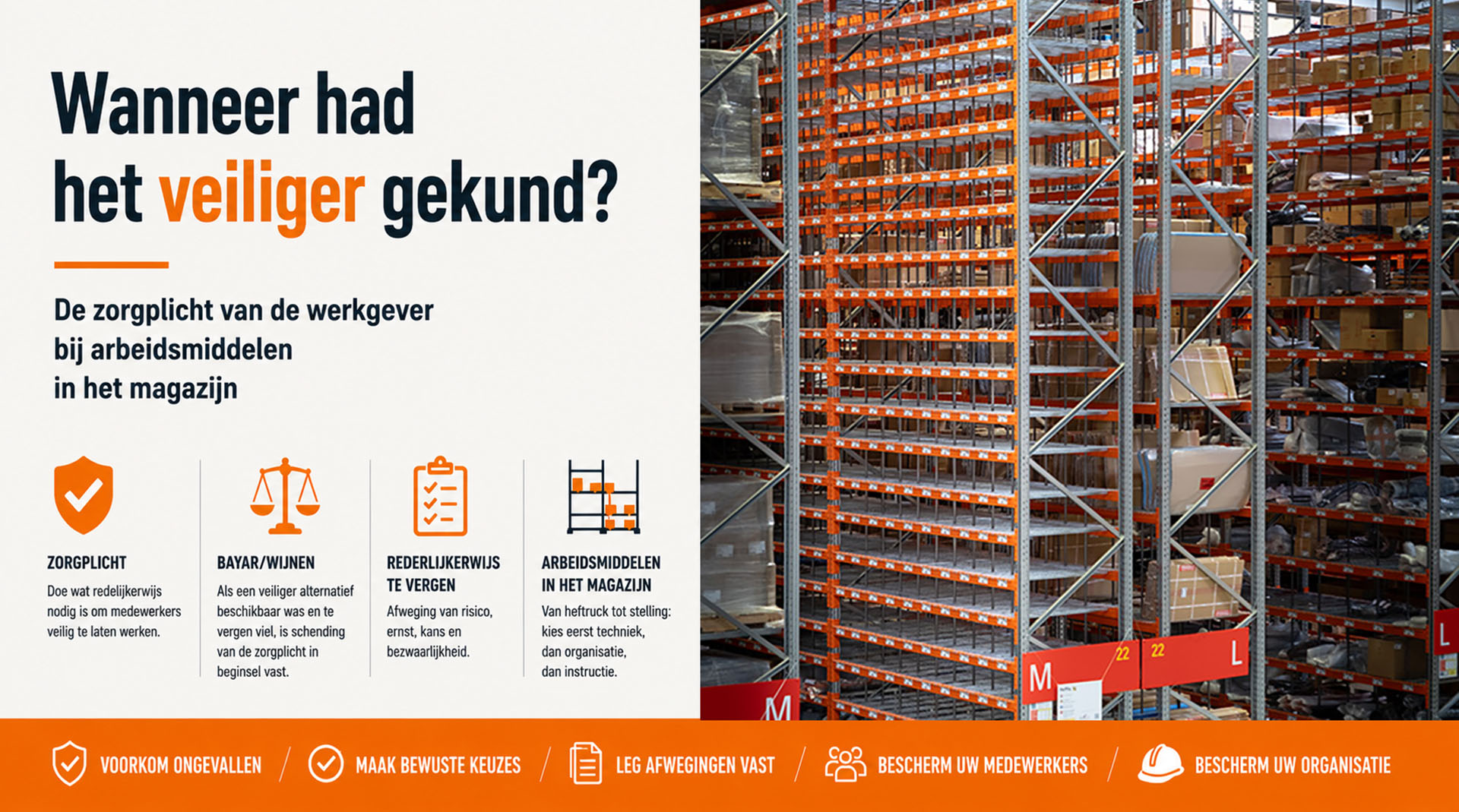
Please note: this article discusses Dutch legislation and case law (article 7:658 of the Dutch Civil Code, the Arbowet / Arbobesluit, and Dutch NEN-EN standards). The information below applies to the Dutch situation and may not be directly applicable in other countries.
An order-picker employee falls from a height of one to two metres out of a large order-picker truck. The subdistrict court (kantonrechter) rules that the employer breached its duty of care — not because the danger was known in advance, but because a safer version of the work equipment was already available within the employer's own fleet. Below is an overview of the standard applied in that assessment, and what it means for work equipment in the warehouse.
A two-metre fall that wasn't necessary
On 28 November 2022, a production employee falls between one and two metres from an order-picker, in a warehouse where orders are made ready for dispatch within a very short time. He thinks he is standing on the ground and steps out — but the safety gate on the large order-picker, unlike on the small one, can also open while at height.
- Even his team leader assumed, until the accident, that the gate on the large order-picker could not open while at height (r.o. 4.13). The specific danger was therefore not known to management in advance.
- The large order-picker could in fact be fitted with an interlock function, similar to the one on the small picker. The employer had deliberately refrained from doing so — this was the situation as it existed before the accident — arguing that this would create new risks in emergencies or in case of fire (r.o. 4.11).
- The investigation report further showed that the employer had asked the supplier to add a new function (r.o. 4.12); the ruling does not state at what point that request was made.
On this basis the subdistrict court finds liability: an equivalent safety provision was already present elsewhere in the employer's own fleet, and the employer's counter-argument did not hold up on the merits (r.o. 4.15). Here, the duty of care is breached on the basis of the objective availability of a safer alternative, not on the basis of prior knowledge of this specific accident scenario.
The rule from Bayar/Wijnen
The court bases this ruling on Supreme Court (HR) 11 November 2005, ECLI:NL:HR:2005:AU3313 (Bayar/Wijnen, NJ 2008/460 note W.H. van Boom), in which a production employee at a meat wholesaler lost three fingertips to a packaging machine.
- When it is established after an accident that a safer alternative was available, and its use could already have been required of the employer before the accident, a breach of the duty of care (art. 7:658(1) of the Dutch Civil Code (BW)) is in principle established.
- Foreseeability of the exact accident scenario is not decisive here. The employer is expected to investigate whether a safer operation of the work equipment is possible, even if it had not foreseen the specific behaviour that led to the accident.
What does "could reasonably be required" mean?
The duty of care under article 7:658(1) BW does not offer an absolute guarantee (HR 5 December 2014, ECLI:NL:HR:2014:3519, Pelowski/Vernooy). The employer must do what is reasonably necessary — not what is technically maximally achievable, and certainly not everything that has since become available elsewhere on the market. One new model at a manufacturer does not, in itself, create an obligation to replace the entire fleet.
This test aligns with the general principle of article 3(1)(b) of the Arbowet: hazards must be tackled at the source wherever possible, and only where that is not possible do technical, organisational and, finally, personal measures (instruction, PPE) come into play — the so-called occupational hygiene strategy or STOP strategy:
- Source measures
- Technical/collective measures
- Organisational measures
- Instruction and personal protective equipment (PPE) — as the last step
This principle is worked out per risk category in the Arbobesluit; for exposure to hazardous substances, for example, in article 4.4. For work equipment, the relevant elaboration is found in Chapter 7 of the Arbobesluit ("Work equipment and specific activities"), without as explicit a numbered step plan applying there as for hazardous substances. The underlying logic, however, is the same, and the Supreme Court applies that logic in Bayar/Wijnen within private law: the employer must first investigate whether an adequate technical measure or a safer operation of the work equipment is possible, and only if that is not the case does the question arise whether an adequately effective warning can be given. Warning while a technical measure was available is, under civil law, not sufficient to satisfy the duty of care. That is precisely why a warning sign was not enough in the order-picker case.
Whether a measure could reasonably be required further depends on:
- Nature of the work and how recognisable the danger is — the more dangerous and the better known, the higher the requirements.
- Probability and severity — the more likely the accident and the more severe the consequences, the more is expected of the employer.
- Burden of the measure — financial, technical, organisational. This is often the decisive point. A manufacturer selling a safer model somewhere is a different matter than an employer that already has the provision in-house: in the latter case, the "not feasible" defence falls away, as in the order-picker case. If the alternative exists only on the market, a reasonable transition period is allowed.
- The "experiential fact" of inattentiveness — according to settled case law, daily use of a piece of work equipment leads to reduced attentiveness, even after instruction.
- Measures taken afterwards — a safety provision fitted after an accident raises the question of why it could not have been fitted earlier.
Work equipment in the warehouse
The same weighing-up applies to virtually every piece of work equipment in a warehouse — racking included, since that too is work equipment within the meaning of article 7:658 BW.
- Forklifts and reach trucks — cameras, blue-spot lighting or a speed limiter that is already standard elsewhere in the fleet.
- Pallet trucks and pump trucks — entrapment and the absence of braking or locking provisions.
- Loading bridges and dock shelters — a mechanical lock instead of only a warning sticker.
- Ladders, steps and (mobile) scaffolds — was the equipment chosen suitable for the nature of the work, or could a scaffold reasonably have been required as a safer alternative?
- Fall-through protection on racking (mesh decking, mesh panels, nets) — NEN-EN 15629, section 8.2, requires that where there is a risk of falling goods, effective preventive measures are established. This is a direct analogy to the Bayar/Wijnen test, but not an existing precedent: as far as is known, there is no published article 7:658 ruling that applies this literally to mesh decking.
- Collision protection on racking (upright and corner protectors) — here it works differently: NEN-EN 15512 and NEN 5056 directly require that adequate collision protection be present at the corners of racking aisles wherever lift trucks are used. This is not an analogy but a concrete normative obligation.
Rack.Parts: for collision protection, the question is therefore not "could this reasonably have been required" but simply "is the standard met". For fall-through protection, it remains a balancing exercise within the open standard of NEN-EN 15629.
RI&E and periodic inspection
Record why a particular piece of work equipment or a particular safety provision was chosen, and why alternatives were weighed up — preferably in line with the Arbowet principle: source and technology first, instruction only after that. The RI&E and its accompanying action plan are the appropriate tool for this.
When an NEN-EN 15635 inspection identifies a lack of fall-through protection or collision protection, that is not only a technical finding — it is also the moment at which the question "was a safer alternative available and could it reasonably have been required" becomes legally relevant, should an accident occur later. A well-substantiated assessment, recorded before the accident, is the best protection against exactly the reproach that was decisive in the order-picker case.


