


Series on Sprinklers and Pallet Racking - Part 2 - Transverse Flue Spaces
0%
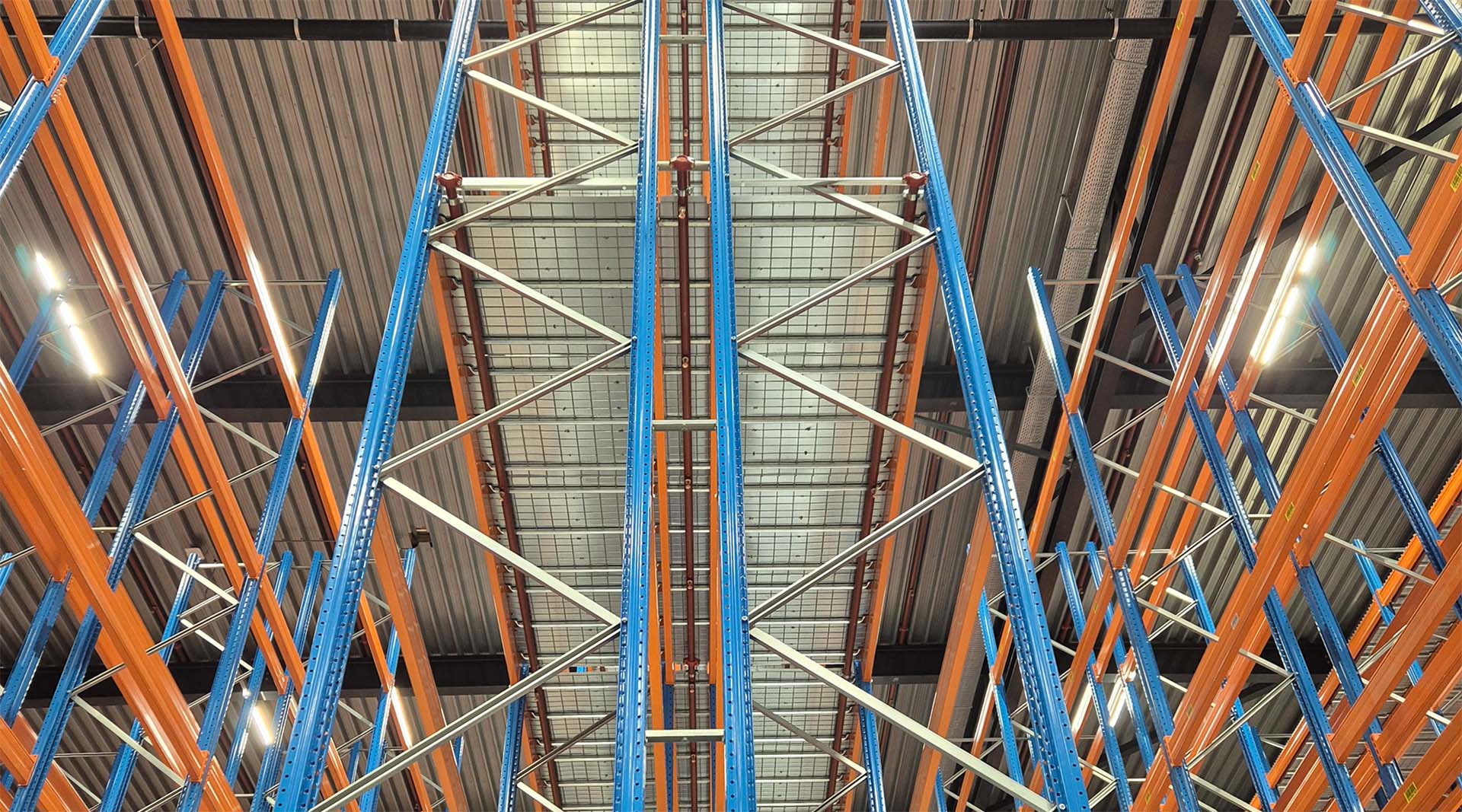
In the previous article we already mentioned that racking must comply not only with construction and ARBO requirements, but also with insurance requirements. To get an overview of all these fire safety requirements and align them with each other, basis-of-design documents exist: the UPDs
Often the requirements included in a UPD are taken from FM Global data sheets. In particular FM Global Datasheet 8-9 is important for your racking.
In that article we then discussed longitudinal flue spaces and the minimum clear space they must occupy. At right angles to the longitudinal flue spaces, and therefore at right angles to the direction of truck travel, are the transverse flue spaces. Transverse flue spaces are therefore found both between the pallets themselves and between the pallets and the frames of the racking.
Since the arrival of ESFR sprinklers in tall Dutch warehouses, in-rack sprinklers are in many cases no longer needed. However, that does require that the flue spaces in the racking are set up in accordance with the regulations and remain maintained. Realizing and maintaining the transverse flue spaces is in practice often more difficult than the longitudinal flue spaces.
In a top view with 2 double rows of pallet racking, the transverse flue spaces look as follows (drawn in yellow)

The width of the transverse flue space must be at least 75 mm and must run straight from top to bottom through the racking. (We recently heard the remark that "you should be able to drop a tennis ball from top to bottom through the transverse flue space onto the floor without hitting any pallets".) This has consequences for the flexibility in your warehouse. After all: placing 4 euro pallets of 800 mm wide on one beam level and 3 block pallets of 1000 mm wide (or pallets of 1100 mm wide) on the level above means that the vertical transverse flue space does not run in a single straight line.
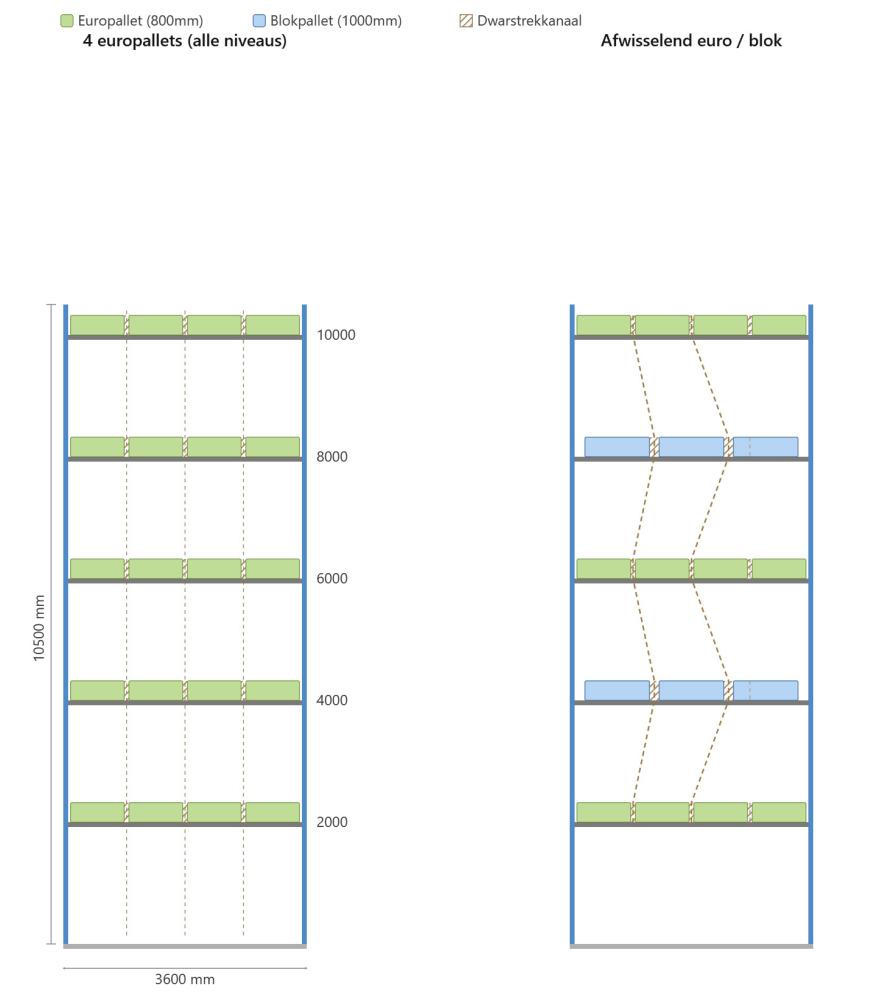
The image above shows the approved situation on the left and the rejected situation on the right. In a warehouse where only euro pallets or only block pallets are used, this is not much of a problem. In a warehouse where both types, and possibly also the Asian Standard Pallet of 1100 mm wide, are used, this is indeed a problem.
Possible solution: dividing your beams into 'fictitious' sprinkler bays
A number of our customers have divided their racking into sprinkler bays. In that case, less attention is paid to optimizing the number of pallets on a beam, and instead bays are created based on the widest commonly occurring pallet in the warehouse, with the beam sizes based on that
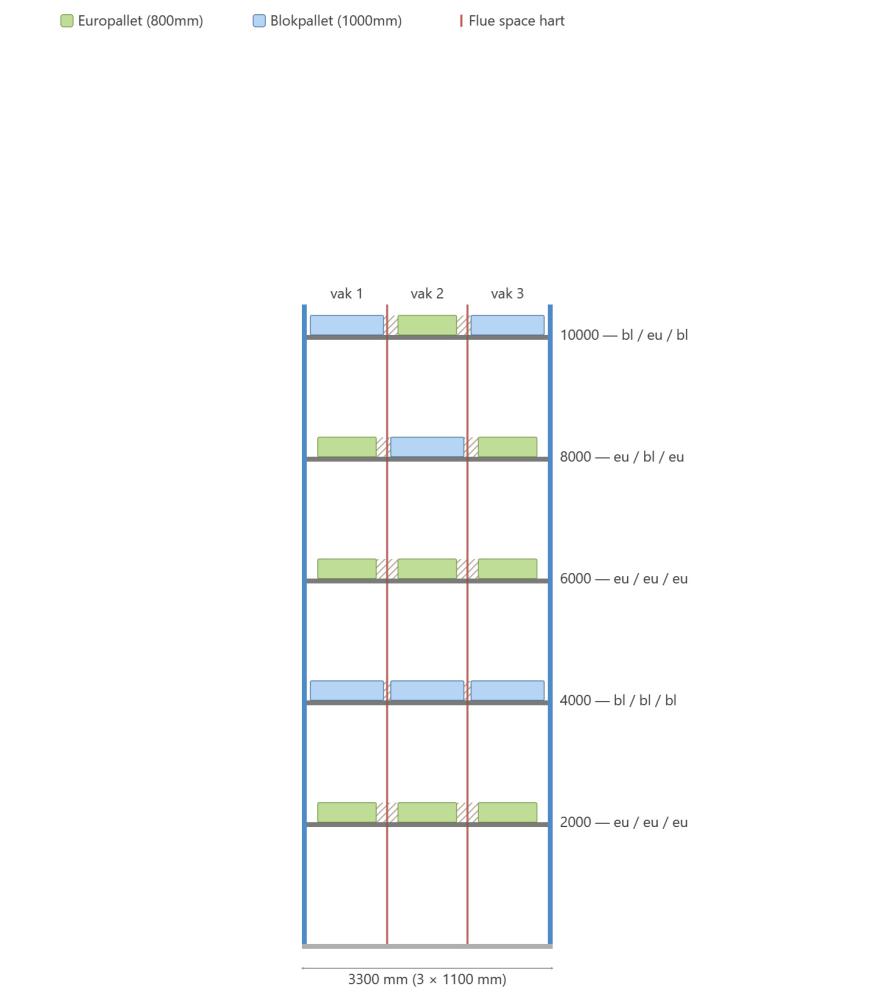
Example 1 - Euro and Block Pallets:
A customer with both euro and block pallets opts for beams 3300 mm wide, based on 3 block pallets. The narrower euro pallets can be placed in the same position as the blocks without the flue space being lost
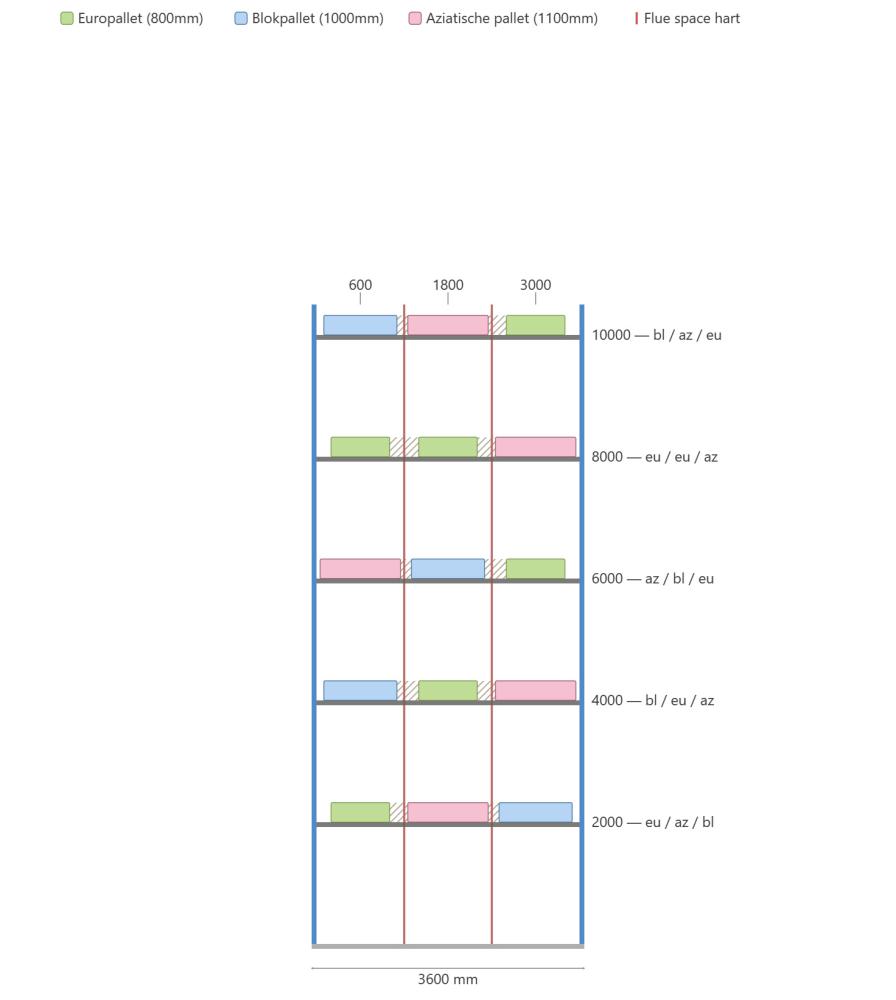
Example 2 - Euro, Block and Asian Standard Pallet
A customer has a warehouse with not only block and euro pallets, but also Asian Standard Pallets of 1100 mm wide. On a beam level of 3600 mm, that looks as follows:
Drawback of sprinkler bays in the last example
It is well known that four euro pallets of 800 mm fit side by side on a beam of 3600 mm. By dividing the beam into 3 so-called sprinkler bays, you therefore lose storage capacity if a lot of euro pallets are placed in your warehouse. The solutions outlined above only apply if other solutions are not feasible from a financial or operational point of view. Those other solutions can be:
- A WMS that always assigns the correct location and takes the requirements from the UPD into account
- A division in the warehouse with racking for euro pallets, and other racking for, for example, block and/or Asian Standard Pallets
Conclusion
Transverse flue spaces in pallet racking are always a limiting factor for flexibility or storage capacity. The alternative, in-rack sprinklers, is an even bigger nightmare for virtually every warehouse manager. If you have a roof-level sprinkler system, first check whether you are able, through your WMS, to meet the requirements for maintaining your transverse flue spaces without losing efficiency. If that doesn't work, look at physical solutions.
Either divide your warehouse into a section for euro pallets, a section for block pallets and a section for other pallets.
Is your turnover rate high, or does the type of pallets you receive vary continuously? Then consider whether you can organize your racking into 'sprinkler bays'.
Next episode
Why does IKEA have those mesh cages on the pick levels in the self-service warehouse
Want to know more? Contact us


