


Employee Dies After Being Struck by a Falling Pallet - Court Identifies 6 Causes
0%
Please note: this article discusses a Dutch court ruling and Dutch legislation (the Arbowet / Arbeidsomstandighedenwet and Arbobesluit). The information below applies to the Dutch situation and may not be directly applicable in other countries.
A new employee dies in a warehouse after a pallet weighing 792 kilograms falls on him. The court imposes a fine of € 100,000 on the employer and establishes why this could have been prevented. Below is an overview of the causes the court identified.
Didam, 20 January 2023. A 36-year-old temporary worker has been working in the warehouse of an industrial door manufacturer for four days. While using a forklift truck to pick up two heavily loaded pallets, they become unstable and fall off the forks. He becomes trapped, most likely sustains a skull base fracture, and dies on the spot from positional asphyxia.
Cause 1
Unsafe stacking of the pallets art. 3.17 Arbobesluit
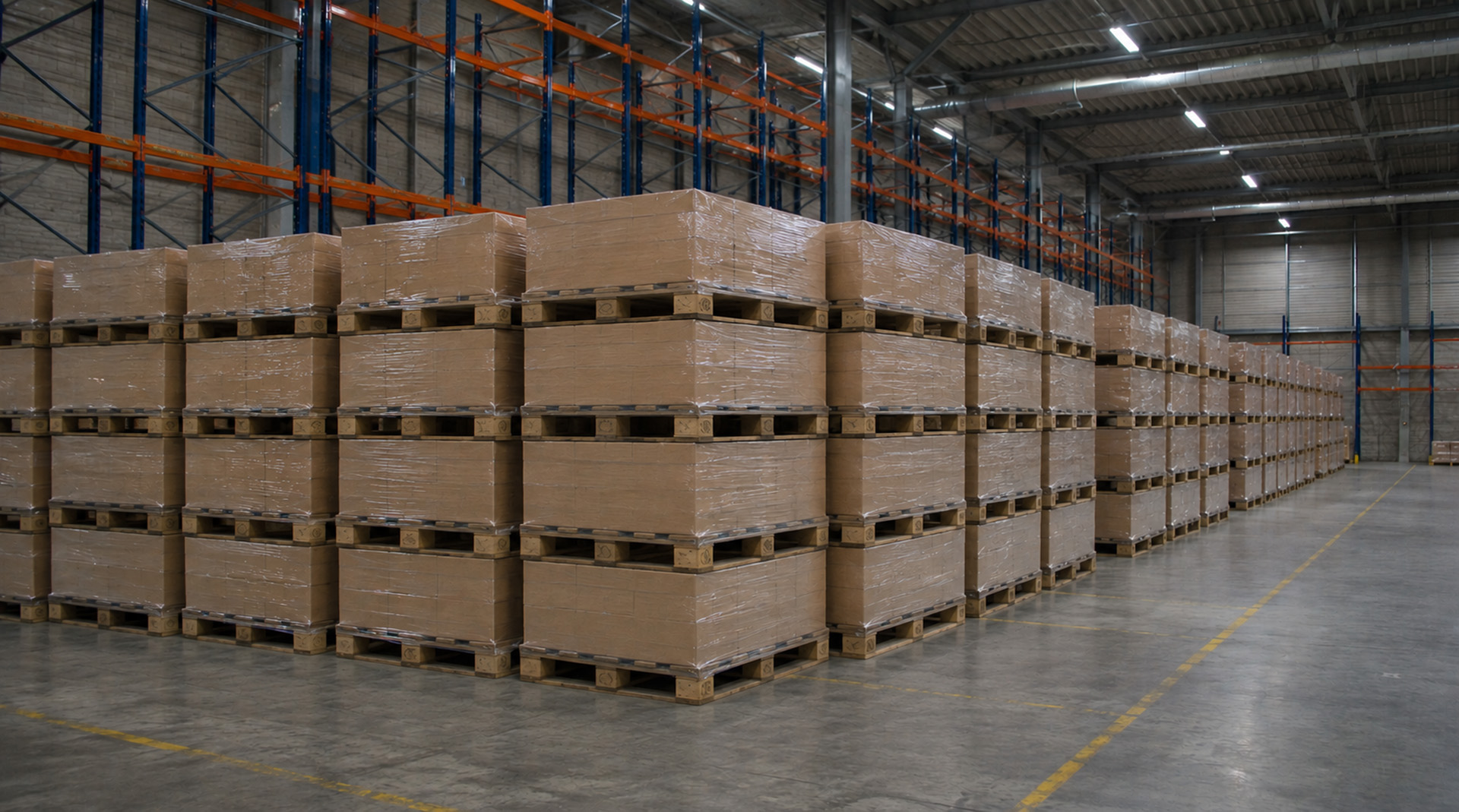
- The pallets were stacked four high, while the supervising foreman explicitly stated that a maximum of two high was permitted.
- The rows stood close together due to lack of space, so the extended forks (1,600 mm) could not be pushed fully under the bottom pallet as far as the heel of the fork carriage — a requirement for a stable lift.
- The quality of the pallets was poor: they were not stacked squarely on top of one another and sagged under the weight of the load.
Cause 2
Unsuitable modified forklift truck art. 7.2 lid 1 Arbobesluit
- The Toyota 7BMF25 (2006) in use was fitted with an extended attachment made by Meyer (type 6-104K, 1,600 mm forks), which turned it into a combined machine within the meaning of the Machinery Directive.
- This modified forklift truck did not have its own CE marking, even though this was a legal requirement.
- When the company was taken over in 2014, it was never established which CE markings and instructions for use applied to the machines on site. The 2019 risk assessment (RI&E) had already flagged this as an outstanding action point, but it was never followed up.
Cause 3
Overloading of the forklift truck art. 7.18 lid 2 Arbobesluit
- The rating plate on the forklift truck showed the rated lifting capacity of the original machine: 2,500 kg. After the attachment was fitted, however, this had not been adjusted.
- Because of the attachment and the longer forks, the actual lifting capacity was lower. Because the pallets also could not be placed fully up to the heel, the load centre shifted forward: at a load centre of 1,600 mm, the actual lifting capacity was only 1,000 kg. (Rack.Parts: the forks of the modified machine turned out to be 1,600 mm long. The load centre can then never also have been at 1,600 mm, but was more likely at 1,000-1,200 mm. We don't know whether this is a typo or something that was overlooked.)
- The combined weight of the two pallets was 1,311 kg — well above the actual permitted working load — which caused the unstable load.
Cause 4
Incomplete risk assessment (RI&E) art. 5 lid 1 Arbowet
- The 2019 RI&E contained no specific risks for working with the modified forklift truck in combination with heavily loaded pallets stacked four high.
- In the 2019 RI&E, the absence of a structural instruction/training plan was classified as priority 1 (high probability of accidents, action required within one year). In 2022 the company itself established that this recommendation still had not been acted on.
- The risk of limited space in the warehouse had been raised internally, but was not described in the RI&E and was not translated into safety measures.
Cause 5
Insufficient instruction of the employee art. 8 lid 1 Arbowet
- The victim had been working in that warehouse for only four days and was shown the ropes by a colleague with limited English.
- He did not speak Dutch or German. The safety instruction he signed was in Dutch; whether he understood its content is therefore not established.
- There were no written work instructions available for working with the modified forklift truck — only a general safety instruction.
- Employees, including the supervising foreman, did not know the actual lifting capacity. They went by the incorrect rating plate and assumed a lifting capacity of 2,500 kg.
Cause 6
No follow-up on earlier warning signs
- The company had previously had five reportable workplace accidents. As a result, employees were verbally warned about risks, but the safety policy and prescribed way of working were not structurally adjusted.
- The court explicitly finds that the company's efforts to prevent accidents were insufficient, even though the company said it took safety seriously.


